Qilin Zhang

Research

Job market paper

Gender-biased Dynastic Savings and the Marriage Market: Evidence from China

Paper (latest version) · Slides

CFPSStructural ModelEvent StudyStataPython

This paper studies how parents’ investments in their children shape the marriage market in China. Using household survey data, I document that the marriage market is assortative and the parents’ investment mix differs by child gender. In a dynastic model of parental investment and marriage matching, I find that the gender difference in education technology lowers the marriage rate: equalizing the technology across genders raises it by 0.62 percentage points. As parents grow richer with China’s growth, the model accounts for 35 percent of the proportional fall in the crude marriage rate between 2010 and 2024 and predicts a further decline. Subsidies to newlyweds raise marriage, whereas equal-sized transfers to parents lower it.

Model-implied marriage rate from 2010 to 2035: total, education composition only, and asset profile only
Model-implied marriage rate, 2010–2035, decomposed into education composition and asset profile channels.

With manuscript

A Micro Anatomy of the Hidden Local Government Debt in China: 2014–2023

Presented at the Southern Economic Association (SEA) Annual Meeting, 2025

WINDStata

Abstract

This paper introduces a newly constructed dataset comprising firm-level and city-level information on 2,940 industrial Local Government Financing Vehicles (LGFVs) across 305 cities in China. Compiled from public disclosures, the dataset includes detailed financial metrics such as assets, liabilities, profitability, and ownership structure at the firm level, alongside key economic indicators at the city level. I document significant heterogeneity in hidden debt exposures across regions and sectors. The dataset supports applications in studying geographic patterns of off-balance-sheet debt and firm-level financial behaviors, providing valuable insights for future research into fiscal transparency and debt sustainability in China.

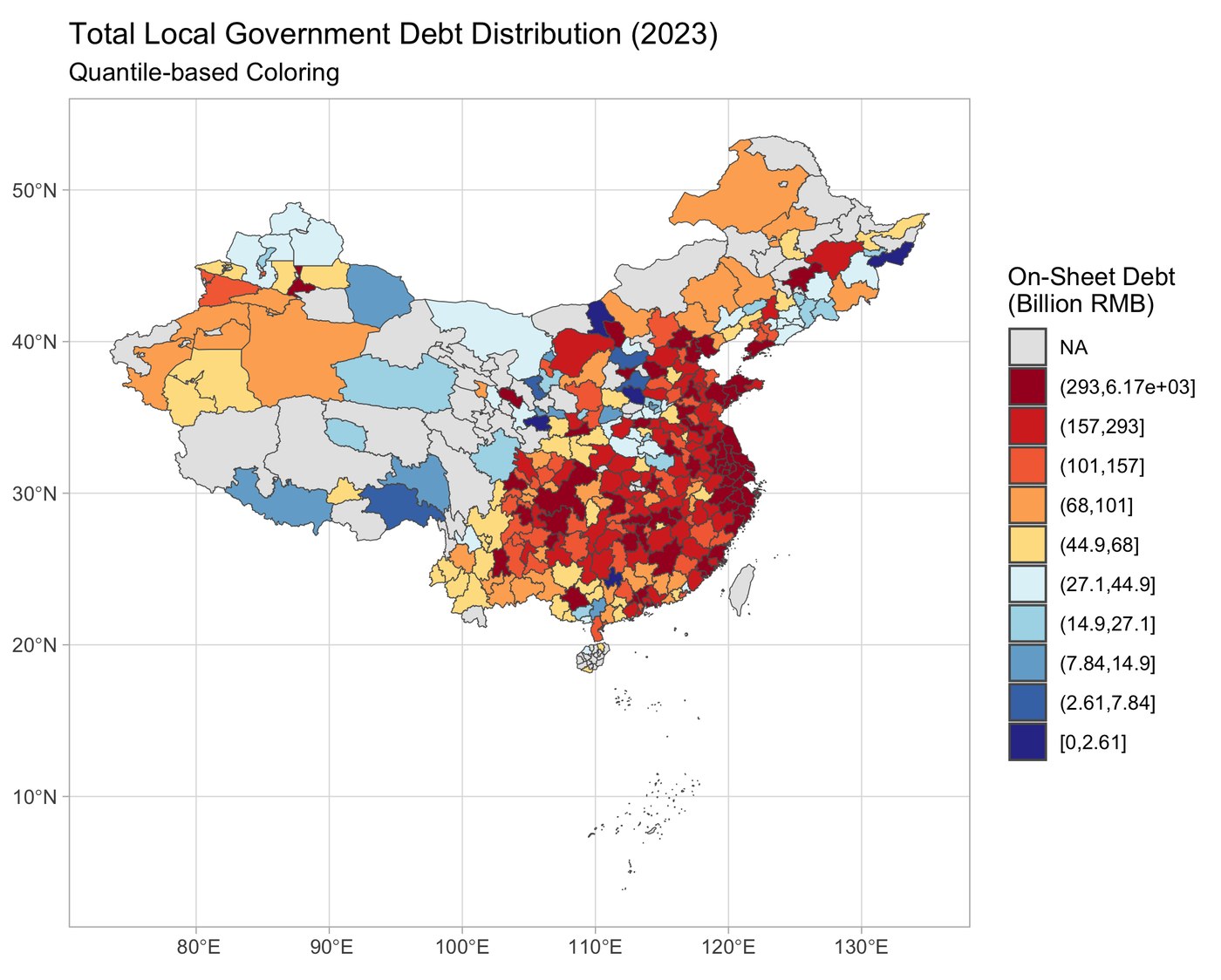
Map of total on-sheet local government debt by prefecture in China, 2023, quantile coloring
Total on-sheet local government debt by prefecture, 2023 (billion RMB).

Work in progress

Pre-Ph.D. research

Dynamic Aspect of Family Transfers under Gender Preference: Evidence from China

Master’s thesis · Advised by Christopher Taber and Long Hong

CHARLSPanel Fixed EffectsStata

Abstract

Intergenerational transfers between family members are an extremely common economic phenomenon, and there are rich theoretical models and empirical work on the China background. As of now, we do not know much about the parental transfers made by Chinese parents to children who do not reside with them. And son-preference is a problem that cannot be ignored in the study of parent-child relations in China. The purpose of this article is to examine whether gender and other child characteristics have an effect on parents' transfer decisions using panel data. I created a panel data with 3 waves from CHARLS and estimated the causal effect of children’s gender on parental transfer using fixed effect models. According to my research, Chinese families have son-preference in parental transfers. Compared to females, men have a 20.3% higher transfer probability and a 1995 RMB higher transfer amount than women. Surprisingly, child income seems to have no effect on parental transfer. This may be due to cultural background differences. Chinese culture values giving money as an expression of love and care to juniors. As a result, parental transfers are more likely to be a form of family interaction rather than financial assistance in China.

Study on China’s Individual Income Tax Reformation on the Basis of Family: Based on the Urban Household Survey (in Chinese)

Undergraduate project · 10,000 RMB funding by SUFE · Advised by Zhikuo Liu

Abstract

The purpose of this study is to design a plan to collect individual income tax by family, to discuss a feasible way of collecting tax by using designed project to calculate the data, and our project aims at alleviating the tax incidence of the wage earners.

Study methods: compare in international range, simulation of tax system, normative analysis. We choose America, England, Japan, Germany, Denmark, India and Singapore to analysis, mainly compare and summary in several aspects such as status of individual income tax, collecting model, the structure of tax rate, benefit of individual income tax.

Data sources: The sampling survey data (UHS) of urban residents living in Liaoning, Shanghai, Sichuan, Guangdong. Sample size: 128866 persons.

Study result: Our country still have a long way to go comparing with those countries developed in individual income tax, following are the reasons: First: The sources of our countries residents’ individual income are complicated, there are some bugs in collecting the tax by sorting the earning. Second: The awareness of taxpayers paying the tax on their owner initiative has been weakened because the fiscal revenue expenditure data disclosure of our country lack of diaphaneity. Third: As a kind of direct tax, the individual income tax has a high discomfort index.

Study conclusion: Combining with the newly direction of the individual income tax reformation of our country, we conclude four suggestions to the government. First: To set up a complete tax information collection and management system by using currently nationwide ID card information system. Second: To launch a collection project which collecting ways combine synthesis and classification. Third: To adopt family coefficient, add a tax collection way of collecting individual income tax by family to alleviate the tax incidence of moderate and low-income citizens. Forth: Gradually improving the fiscal revenue expenditure data disclosure to enhance the awareness of taxpayers.

Research experience